
The climate delay trap: why don’t we act on the most important risks?
Every year ahead of Davos, the World Economic Forum (WEF) produces its Global Risk Report, surveying senior leaders on the biggest threats over the next two years and ten years.
It doesn’t make for light reading: the cover of the 2026 edition is a picture of planet Earth on the edge of a cliff, silhouetted by ominous red lighting. But, beyond striking fear into your heart, the report also presents a useful opportunity to look back at which issues have dominated over the last ten years. When we analysed the past ten years of reports, the result is fascinating for what it reveals about the climate: a continued recognition that the risk is important, matched by a continued deferral of responsibility to deal with it.
In each report, environmental risks have consistently appeared as the most serious threats over the 10-year horizon; however, these same risks have appeared less consistently at the very top, in short-term (two-year) rankings, which often shift toward geopolitical, economic, or security concerns. For example, the risk most selected by respondents as ‘most likely to present a material crisis’ in 2026 was geo-economic confrontation (18%), with state-based armed conflict coming in second (14%).
We might call this divergence between long-term risk recognition and fluctuating short-term prioritisation the ‘climate delay trap’. It’s a structural challenge; acknowledged long-term threats struggle to achieve short-term political attention and action, particularly in periods of acute geopolitical stress. While WEF reporting frames environmental risks as urgent and present-day, they note a majority of such risks have declined in ranking against a context of ‘multipolarity and protectionism’.
Environmental risks do show up in the short-term to an extent – but often only in the most visible forms. ‘Extreme weather events’ (8%) is third this year, suggesting climate breaks through when easiest to see and quantify. The more diffuse aspects of climate risk like ‘critical changes to earth systems’ (only 2% of votes) are harder to act on, but with huge impacts. Some of the biggest killers in developing countries are going to be intensified by climate, weakening our ability to combat these diffused health impacts (despite progress in recent decades). We face, for example, a potential ‘excess of 250,000 deaths per year by 2050 attributable to climate change’ through ‘heat, undernutrition, malaria and diarrheal disease’ (IPCC).
For businesses, the risk is both moral and practical. Climate impacts can threaten operations and license to operate, but the pathways to mitigation and resilience can feel complex because of how the risk is distributed across value chains, and because we only really mitigate the problem if everyone else acts too. Action must ultimately be systemic.
The climate delay trap asks us: how do businesses translate chronic, systemic risks into sustained near-term decision-making and action? Here are some practical principles to escape the trap:
Make climate change ‘now’: Treat climate change as a near-term operating risk, not distant issue. It is already happening (and only getting worse).
Make climate change ‘concrete’: Translate climate risks into concrete operational terms, mapped to the specific value chain of your business. If risks are clear and tangible to colleagues, they can act on them.
Make climate change ‘jargon-free’: Frame climate action around clear, direct and business-centric language based where you can make the most difference. Emission ‘scopes’, mitigation vs adaptation, and accounting frameworks should serve impact, not the other way around.
Make climate change ‘integrated’: Build in resilience and limit risk exposure as part of core enterprise risk management (ERM) processes.
Make climate change ‘governed’: Ensure climate risk is built into governance, measurement and reporting (aligned to key legislation).
Make climate change ‘collective’: Advocate for wider policy shifts and system changes, in recognition that collective efforts are essential to make a real difference.
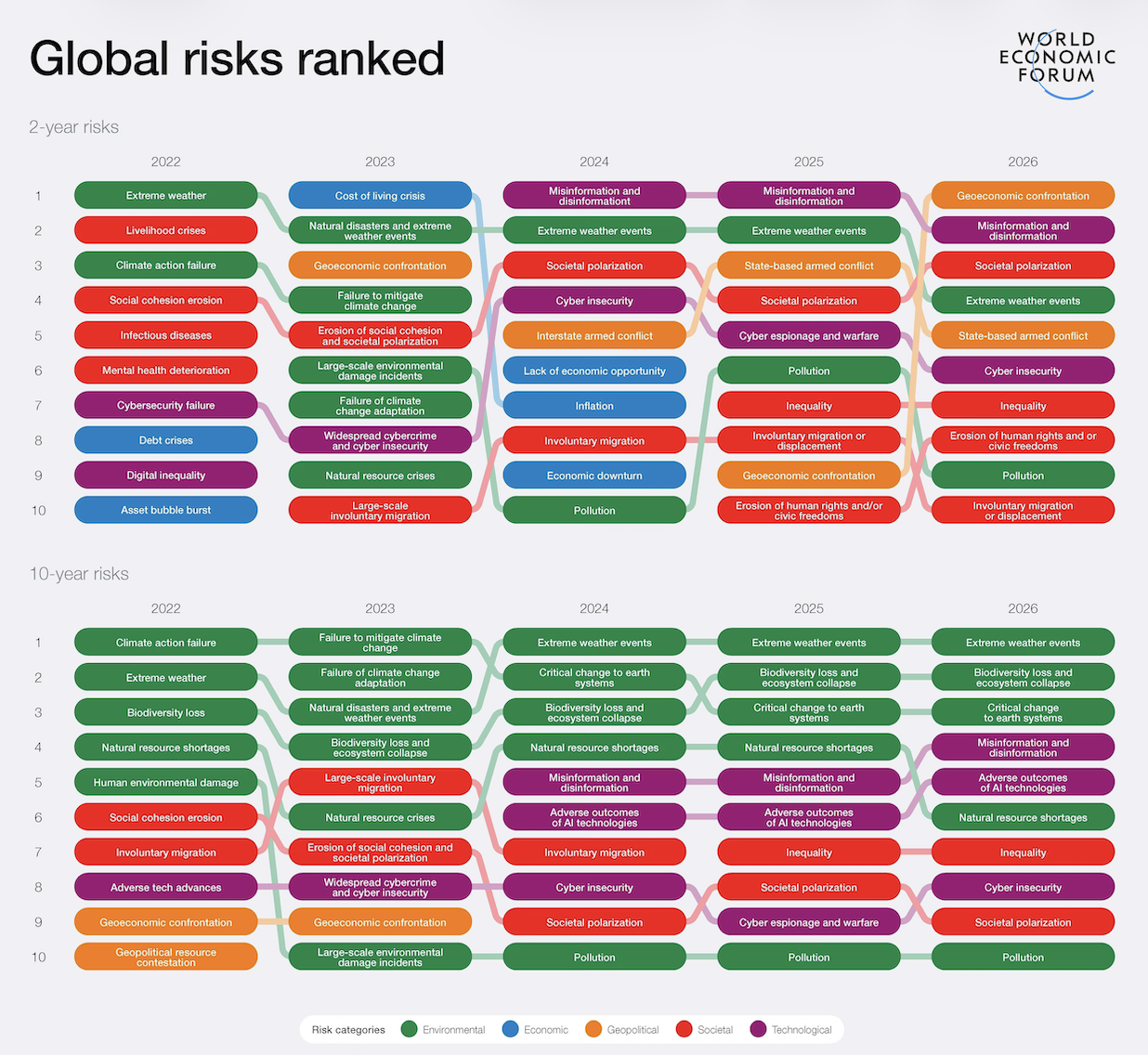
Fig. 1: Over the 10-year horizon, environmental risks (in green) predominate, but far less so in the short term. See WEF for more.
If you have questions, want to learn more about climate change, or just fancy a chat, please reach out to hello@brodiepartners.com
Written by Benjamin Sobel, Senior Analyst